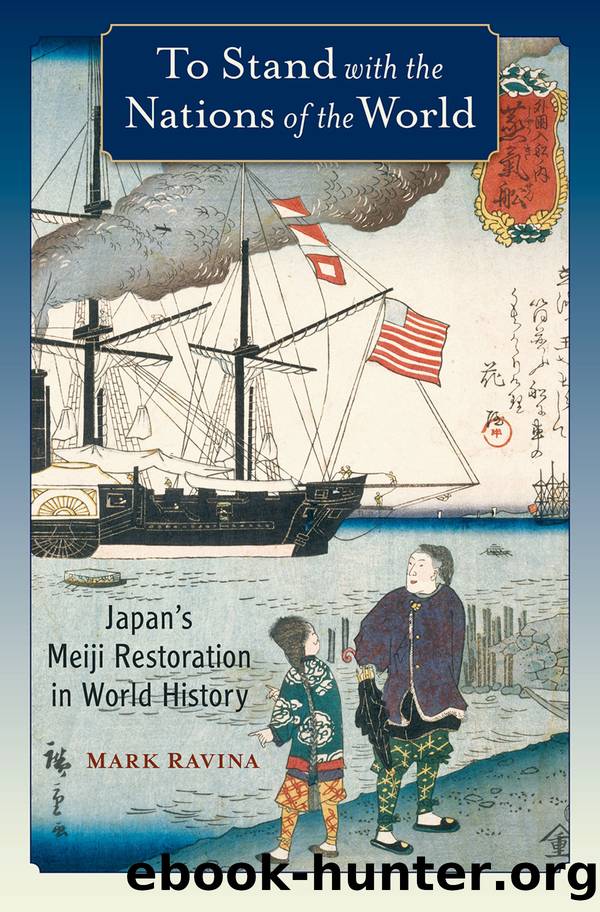
To Stand with the Nations of the World by Mark Ravina
Author:Mark Ravina [Ravina, Mark]
Language: eng
Format: epub
Published: 2017-12-15T00:00:00+00:00
6
The Prudent Empire
LIKE THE CARETAKER government, the Åkubo administration sought to establish Japan as a sovereign power within the nineteenth-century European international system. Unlike the caretaker government, however, the Åkubo administration was convinced that this project would take decades. Those who had seen Europe and America firsthand on the Iwakura mission were deeply aware of Japanâs material and technological inferiority. Only after decades of economic development and technological modernization could Japan overcome that inferiority and negotiate with the Great Powers from a position of strength. Accordingly, the government focused on consolidating state power and promoting economic growth. It reformed the land tax, creating the most uniform national tax system in roughly a millennium. It dismantled the samurai class and began building a modern army and navy based on commoner conscripts. It poured funds into a range of infrastructure and industrial projects, including mines, railroads, telegraphs lines, iron and steel foundries, shipyards, and textile mills as well as factories for glass, lacquer ware, ceramics, and soap.1 The new government fully believed that it could raise Japan to great power status, but it knew that such a transformation would require mastering the Industrial Revolution, not stoking revolutionary passions. Former samurai might clamor for a war of honor in Korea or Taiwan, but Japanese diplomacy needed to be grounded in prudent realpolitik. Popular sentiment was something to be tamed rather than mobilized. Historian Banno Junji has described this face of Meiji politics as âdevelopmental despotismâ (kaihatsu dokusai).2
The Åkubo government confronted two main forms of opposition: reactionary opposition to reform and burgeoning demands for popular representation. Despite their differences, those two movements were united in their opposition to the autocracy of the Åkubo cabinet. In response, the administration tried both to placate and to suppress its challengers. In 1874, it staged a punitive attack on Taiwan to appease demands for a more aggressive foreign policy, specifically from disgruntled samurai in the southwest. But when small groups of disaffected samurai launched violent attacks, the state responded with overwhelming force. In January 1877, such confrontations exploded into a full civil war after followers of SaigÅ Takamori raided an armory in Kagoshima and began marching north to Tokyo. The Meiji state mobilized nearly 60,000 soldiers and sailors against a rebel army of roughly 30,000, and by March the rebels were in retreat. The fighting dragged on until late September as the rebels managed to evade the advancing Imperial Army. The Meiji state won the War of the Southwest, also known as the âSatsuma Rebellion,â but at enormous financial and human cost. At least 10,000 combatants died in the fighting and the Meiji governmentâs direct military costs were over 40 million yen, roughly a half-yearâs revenue. The financial implications of the war lasted well beyond the nine months of combat. The government covered its expenses largely by printing money, causing the value of the yen to plummet. Prices soared for basic commodities such as rice, charcoal, and salt.3
The government also faced non-violent demands for greater political inclusion, most pointedly, calls for the creation of an elected national assembly.
Download
This site does not store any files on its server. We only index and link to content provided by other sites. Please contact the content providers to delete copyright contents if any and email us, we'll remove relevant links or contents immediately.
| Africa | Americas |
| Arctic & Antarctica | Asia |
| Australia & Oceania | Europe |
| Middle East | Russia |
| United States | World |
| Ancient Civilizations | Military |
| Historical Study & Educational Resources |
The Dawn of Everything by David Graeber & David Wengrow(1763)
The Bomber Mafia by Malcolm Gladwell(1664)
Facing the Mountain by Daniel James Brown(1598)
Submerged Prehistory by Benjamin Jonathan; & Clive Bonsall & Catriona Pickard & Anders Fischer(1494)
Wandering in Strange Lands by Morgan Jerkins(1482)
Tip Top by Bill James(1480)
Driving While Brown: Sheriff Joe Arpaio Versus the Latino Resistance by Terry Greene Sterling & Jude Joffe-Block(1410)
Red Roulette : An Insider's Story of Wealth, Power, Corruption, and Vengeance in Today's China (9781982156176) by Shum Desmond(1395)
Evil Geniuses: The Unmaking of America: A Recent History by Kurt Andersen(1391)
The Way of Fire and Ice: The Living Tradition of Norse Paganism by Ryan Smith(1369)
American Kompromat by Craig Unger(1359)
F*cking History by The Captain(1350)
It Was All a Lie by Stuart Stevens;(1341)
American Dreams by Unknown(1317)
Treasure Islands: Tax Havens and the Men who Stole the World by Nicholas Shaxson(1304)
Evil Geniuses by Kurt Andersen(1296)
White House Inc. by Dan Alexander(1243)
The First Conspiracy by Brad Meltzer & Josh Mensch(1214)
The Fifteen Biggest Lies about the Economy: And Everything Else the Right Doesn't Want You to Know about Taxes, Jobs, and Corporate America by Joshua Holland(1159)
